Criselle Julian
Project Manager, PropulseVA
Criselle Julian is Project Manager at PropulseVA. Criselle manages client onboarding, project execution timelines, and virtual assistant performance support. Leveraging deep expertise in AI tools and agile project management, she ensures seamless daily operations between clients and their dedicated PropulseVA virtual assistants.
- Project Manager at PropulseVA
- Specialist in Client Onboarding & Project Execution
- Expert in Agile Workflow Tracking & AI Productivity
Executive Summary
Offshore and onshore virtual assistants solve the same operational problems — inbox, CRM, scheduling, follow-up, admin — but they differ in cost structure, time-zone overlap, local business context, management requirements, and the employment model behind them. Neither is universally better. An onshore VA typically costs more but offers native local context and same-hours availability; an offshore VA (commonly Philippines-based) typically costs less and can offer timezone overlap with US, UK, and Australian business hours. The right choice depends on the role's communication demands, customer-facing exposure, judgment requirements, and the employer's management capacity. Use the COST → COMMUNICATION → OVERLAP → MANAGEMENT → FIT framework to decide.
Offshore vs Onshore: Quick Comparison
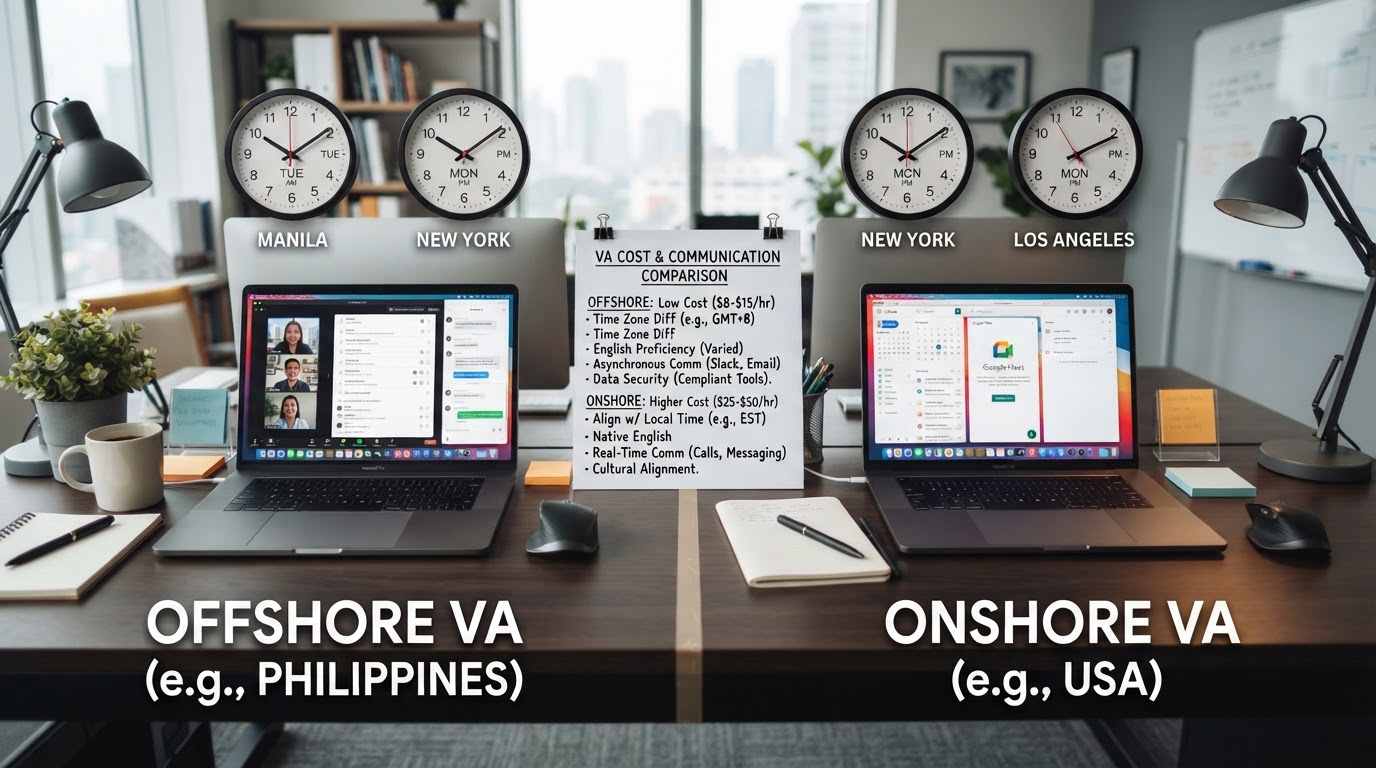
"Onshore" usually means a VA located in the same country as the employer (for a US business, a US-based VA). "Offshore" means a VA located in another country — most commonly the Philippines for English-speaking markets. The distinction matters because it changes cost, hours, context, and management.
For a deeper cost lens, see our US VA cost per hour guide and our Filipino VA cost breakdown.
| Factor | Onshore VA | Offshore VA | What Matters |
|---|
| Cost | Higher (US rates) | Lower (offshore rates) | Budget and role volume |
| Communication | Native local idiom | Strong English; may need context | Customer-facing exposure |
| Time-zone overlap | Same hours | Partial to full overlap possible | Real-time collaboration need |
| Local context | High | Builds over time | Industry/local nuance |
| Management | Standard employment norms | May need async systems | Owner management capacity |
| Employment model | W-2 / contractor norms | Direct hire or managed provider | Compliance and admin |
The COST → COMMUNICATION → OVERLAP → MANAGEMENT → FIT Framework
Rather than asking "is offshore or onshore better," work through five decision variables in order. Each one narrows the answer.
1. COST
What is the realistic total service cost — not just the hourly rate? Onshore VAs carry higher wages; offshore VAs may include agency or management layers. See our managed VA services guide for how service layers affect price.
2. COMMUNICATION
How much customer-facing or high-context communication does the role require? The more native local nuance matters, the more onshore or highly-trained offshore talent is justified.
3. OVERLAP
Do you need real-time collaboration, or can work be asynchronous? Philippines-based VAs can overlap US morning hours and UK/AU afternoons, but overnight work is not automatically required.
4. MANAGEMENT
Can you manage a remote worker with SOPs and reporting, or do you need a managed provider? See our VA management guide.
5. FIT
Match the model to the role. A back-office CRM role may fit offshore well; a high-context client-facing role may favor onshore or a carefully vetted offshore specialist.
How the Answer Changes by Business
The same offshore-vs-onshore question produces different answers depending on the business. Here are four realistic scenarios.
Scenario 1: US ecommerce founder
Back-office order processing, inventory updates, and customer support tickets. Offshore fits well — the work is documented, the cost savings compound across volume, and Philippines-based support can overlap US business hours. Onshore may be reserved for a brand-voice social role.
Scenario 2: US law firm
Intake, scheduling, and document organization. Offshore can handle much of this, but client-facing intake may require strong local context and confidentiality safeguards. A managed offshore provider with legal-workflow experience may fit better than a generic freelancer. See our legal VA Philippines guide.
Scenario 3: Australian service business
An AU company serving AU customers needs AU-hours coverage. Philippines-based VAs can work AU business hours with reasonable overlap. Onshore AU talent costs more and may be harder to source for niche admin roles.
Scenario 4: UK agency
A UK marketing agency needs CRM, reporting, and client comms. Offshore support can handle operations during UK afternoon overlap, while onshore talent handles sensitive client relationships.
Cost Comparison
Onshore US VAs typically command significantly higher hourly rates than Philippines-based VAs. But comparing only the hourly rate is misleading. A managed offshore VA may include recruitment, vetting, and replacement in its fee, while a direct onshore hire carries payroll taxes, benefits, equipment, and supervision costs. For the full breakdown, see our VA cost per hour USA guide.
The key principle: compare total labor cost (onshore) against total service cost (offshore managed or direct), not just headline rates.
Communication and Local Context
Onshore VAs bring native familiarity with local business norms, idioms, and customer expectations. This matters most for customer-facing roles where subtle context affects trust. Offshore VAs — particularly from the Philippines — typically have strong English proficiency, but local industry context (US real estate norms, UK legal terminology, AU insurance workflows) must be built through onboarding and SOPs. It is not automatic.
Avoid broad cultural stereotypes. Communication quality is an individual and role-specific trait, not a nationality guarantee.
Time-Zone Overlap
The Philippines (UTC+8) overlaps US Eastern morning hours, UK afternoons, and Australian business hours almost directly. This makes same-hours or partial-overlap models feasible without forcing overnight work. For scheduling models, see our time-zone management guide.
Management and Employment Model
Onshore VAs usually follow familiar local employment or contractor norms. Offshore VAs can be direct hires (employer owns everything), or engaged through a managed provider that handles payroll, compliance, and replacement. The management burden is the real variable: if you lack time to recruit, vet, and manage, a managed offshore model may create more value than a cheaper direct hire. See our managed vs direct hire guide.
Security and Access
Security practices apply to all remote workers regardless of location. Use unique user accounts, password managers, MFA, and least-privilege access whether the VA is onshore or offshore. Geography does not determine trust; access controls do. See our secure password sharing guide.
Decision Tree: Offshore or Onshore?
If the role is back-office, documented, and cost-sensitive → offshore (often Philippines-based) likely fits.
If the role is high-context, customer-facing, and local-nuance-heavy → onshore or a carefully vetted offshore specialist.
If you need same-hours real-time collaboration → onshore, or offshore with explicit overlap agreement.
If you lack management capacity → managed provider (offshore or onshore) rather than direct hire.
If budget is the primary constraint and work is repeatable → offshore direct hire or managed.
Trade-Offs Summary
Offshore trade-offs: lower cost, strong English, timezone flexibility — but local context must be built, and direct hires require management. Onshore trade-offs: native context and same hours — but significantly higher cost and narrower talent pool for niche admin roles.
Choose based on role requirements and operating model, not on a universal preference.