Executive Summary
Whether to hire a virtual assistant, automate the task, or use both depends on how much judgment the work requires. The JUDGMENT → HUMAN, RULES → AUTOMATION, EXCEPTIONS → HYBRID framework provides the answer: tasks requiring judgment and context-handling belong to a human VA; predictable, rules-based tasks belong to automation; and tasks with a repetitive core but frequent exceptions fit a hybrid model where automation handles the routine steps and a VA monitors exceptions and quality. Most businesses benefit from a combination, not a choice between the two. For the foundational comparison, see our VA vs automation guide.
The JUDGMENT → HUMAN, RULES → AUTOMATION, EXCEPTIONS → HYBRID Framework
JUDGMENT → HUMAN
If the task requires interpreting context, making nuanced decisions, or handling sensitive communication, a human VA owns it.
RULES → AUTOMATION
If the task is predictable, repeatable, and rules-based with no judgment needed, automate it.
EXCEPTIONS → HYBRID
If the task has a repetitive core but frequent exceptions, automate the routine and let a VA handle exceptions and quality.
Decision Matrix: Delegate, Automate, or Hybrid?
| Task | Human VA | Automation | Hybrid | Why |
|---|
| Lead follow-up | Qualify, build rapport | Auto first-touch + reminder | Yes | Repetitive first step; human handles replies |
| CRM updates | Fix messy data, dedupe | Auto-sync fields | Yes | Sync automates; human cleans exceptions |
| Inbox | Triage, respond | Auto-sort + labels | Yes | Filter automates; human responds |
| Calendar | Negotiate complex meetings | Auto-confirm simple bookings | Yes | Simple = automate; complex = human |
| Reports | Interpret, narrate | Auto-pull data | Yes | Data = automate; insight = human |
| Invoice reminders | Handle disputes | Auto-send sequence | Yes | Reminders = automate; disputes = human |
| Customer support | Complex cases, empathy | Auto-FAQ + routing | Yes | Routine = automate; complex = human |
| Scheduling | Coordinate preferences | Auto-book from calendar | Yes | Standard = automate; custom = human |
| Social media | Create, engage | Auto-schedule posts | Yes | Publishing = automate; creation = human |
| Research | Synthesize, judge | Auto-collect data | Yes | Collection = automate; synthesis = human |
| Data transfer | Handle format exceptions | Auto-sync | Yes | Predictable = automate; exceptions = human |
| Review requests | Respond to reviews | Auto-send request | Yes | Request = automate; response = human |
Human VA vs Automation vs Hybrid: Definitions
HUMAN VA
Handles judgment, context, exceptions, and sensitive communication. Best when the work varies, requires interpretation, or involves relationships.
AUTOMATION
Runs reliable, repeatable rules without human intervention each cycle. Best when the steps are predictable and systems can communicate. Tools include Zapier, n8n, APIs, and platform-native workflows.
HYBRID
Automation handles repetitive steps; a VA monitors exceptions, verifies quality, and handles edge cases. This is the most common optimal state for real businesses.
Worked Examples
Example 1: Lead follow-up
Automation sends an instant first-touch message and a reminder sequence. A human VA reads replies, qualifies intent, books appointments, and escalates pricing exceptions. The hybrid model captures speed (automation) and judgment (human). For CRM-specific follow-up, see our VA lead follow-up guide.
Example 2: CRM maintenance
Automation syncs fields between tools and updates stage changes. A human VA deduplicates records, fixes messy data, and tags leads that automation cannot classify. For CRM delegation, see our CRM delegation guide.
Example 3: Customer service
Automation routes tickets, answers FAQs, and acknowledges receipt. A human VA handles complex cases, empathy-sensitive issues, and escalations. Pure automation fails on nuanced problems; pure human handling wastes time on routine ones.
When to Choose Each
Choose a human VA when: the task requires judgment, context, relationships, or exception-handling that rules cannot capture.
Choose automation when: the task is predictable, repeatable, rules-based, and the systems involved can communicate.
Choose hybrid when: the task has a repetitive core but frequent exceptions — automate the routine, human the rest.
For documenting which tasks go where, see our delegation guide and SOP framework.
Trade-Offs
- Automation is fast and consistent but brittle on exceptions.
- A human VA is flexible and judgment-capable but slower and costlier per task.
- Hybrid captures both but requires setup and ongoing coordination.
- Over-automating judgment-heavy tasks creates poor customer experiences.
- Over-delegating rules-based tasks to humans wastes expensive capacity.
Common Mistakes
- Automating a task before documenting the rules — automation codifies confusion.
- Hiring a VA to do what automation should do — wasting human capacity on repetitive work.
- Assuming automation replaces the VA — most businesses need both.
- Building automation without a human monitoring exceptions — errors compound silently.
Decision Tree
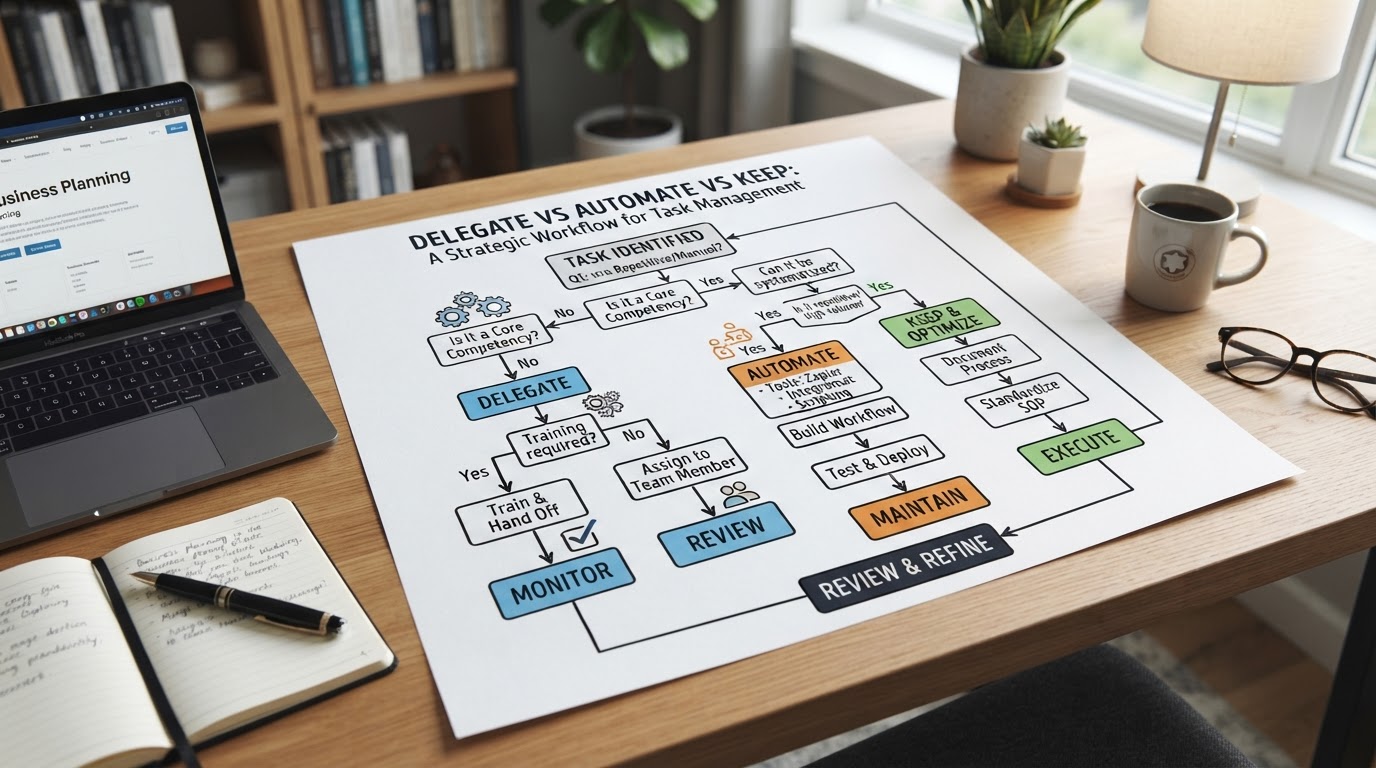
Does the task require judgment or context? → Yes: Human VA. No: continue.
Is the task predictable and rules-based? → Yes: Automation. No: continue.
Does it have a repetitive core with frequent exceptions? → Yes: Hybrid.